
King’s Theory of Pediplanation (1953)
Lester C. King, a South African geomorphologist, proposed pediplanation as a cyclic model of landscape evolution, especially suited to semi-arid and savanna regions. It was formulated as an alternative to W. M. Davis’s “normal cycle of erosion” (peneplanation). Pediplanation is the process by which a landscape is reduced to an extensive, gently sloping erosional surface called a pediplain, through the parallel retreat of slopes (scarp retreat) and the coalescence of pediments, leaving isolated residual hills called inselbergs.
Salient features of theory
- Rapid initial uplift: Uplift is rapid and takes place before erosion begins in earnest, followed by a long period of stability.
- Parallel slope retreat: Valley sides do not decline in angle (as Davis held). They retreat backward while keeping a constant steep angle.
- Four slope elements (King’s “fourfold unit slope”):
- Waxing slope (convex crest): the upper rounded summit.
- Free face (scarp): the steep rock face, the zone of active retreat.
- Debris slope (constant slope): the talus-covered, straight slope below the free face.
- Pediment (waning slope): the concave, gently inclined rock surface at the base, which extends as the scarp retreats.
- Pediment extension: As the free face retreats, the pediment grows in area at the expense of the upland.
- Pediment coalescence: Neighbouring pediments merge to form the pediplain.
- Inselbergs: The last remnants of the retreating uplands survive as residual hills (e.g., bornhardts, koppies).
- Base-level control: Local base level controls the pediment gradient; the pediplain slopes gently toward the main drainage line.
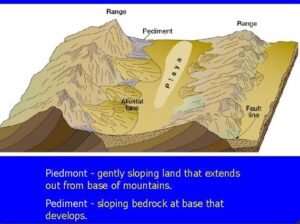
Stages of Pediplanation (King’s theory)
King retained Davis’s idea of a cycle with youth, maturity, and old age, but the processes inside each stage are different. The cycle starts with rapid uplift and a fall in base level, and the landscape then passes through the following stages.
1. Youth
- Rapid uplift is followed by a long period of crustal stability.
- Rivers cut deep, narrow valleys and gorges into the uplifted surface. Because the uplift is sudden, vertical (downward) erosion dominates.
- Steep valley sides develop, each with a free face (scarp) and a debris slope below it.
- Pediments appear only as narrow strips at the foot of the scarps.
- Most of the original upland surface is still intact, and relief is high.
2. Maturity
- Downcutting slows as streams approach their local base level, and lateral erosion becomes dominant.
- The scarps retreat backward while keeping a constant steep angle (parallel retreat), rather than flattening as in Davis’s model.
- As the free face recedes, the pediment at its base widens and extends headward at the expense of the upland.
- The original upland shrinks into isolated, scarp-bounded residual masses, such as mesas and plateaus.
- Neighbouring pediments begin to approach one another.
- Relief is at its greatest in the early part of this stage and then begins to decline.
3. Old Age
- Retreating scarps eventually consume the uplands, and adjacent pediments coalesce into one extensive, gently sloping surface, the pediplain.
- The pediplain is a nearly level, concave-profiled plain with a very gentle slope toward the main drainage line.
- Isolated remnants of the former uplands stand above it as inselbergs (bornhardts, koppies, castle kopjes), which are the equivalent of Davis’s monadnocks.
- Relief is at a minimum, and erosion is slow, mainly by sheet wash and weathering.
Beginning of the new cycle
A fresh uplift or fall in base level rejuvenates the landscape. Streams start incising into the pediplain, and a new cycle begins. Remnants of older pediplains may survive as stepped, higher-level surfaces. King used this to explain the multiple planation surfaces seen across Africa.
| Stage | Dominant process | Slope features | Landscape result |
|---|---|---|---|
| Youth | Vertical downcutting | Steep valley sides, narrow pediments | High relief, deep valleys |
| Maturity | Scarp retreat, pediment extension | Wider pediments, shrinking uplands | Isolated residual masses |
| Old age | Pediment coalescence | Gentle concave pediplain | Pediplain with inselbergs |
Comparison of Davis model and King’s theory of pediplanation
Both are cyclic models of landscape evolution. Both begin with rapid uplift followed by a long period of stability, and both pass through youth, maturity, and old age. They differ mainly in climate, slope processes, and the end product.
| Basis | Davis (Peneplanation) | King (Pediplanation) |
|---|---|---|
| Year and scholar | W. M. Davis, 1899 | L. C. King, 1953 |
| Climatic setting | Humid temperate (“normal” cycle) | Semi-arid and savanna regions |
| Starting condition | Rapid uplift, then long stability | Rapid uplift, then long stability |
| Dominant agent | Running water (rivers) | Scarp retreat, sheet wash, and pedimentation |
| Dominant erosion | Vertical erosion in youth, then lateral erosion and slope wasting | Vertical erosion in youth, then lateral (backward) erosion of slopes |
| Slope evolution | Slope decline: valley sides flatten gradually, becoming convex-concave | Parallel retreat: slopes keep a constant steep angle while moving backward |
| Slope profile | Convex upper slope, concave lower slope | Four elements: waxing slope, free face, debris slope, pediment |
| Key landform of maturity | Dissected, rounded hills and broad valleys | Pediments extending from retreating scarps |
| Role of the pediment | Not a central feature | Central feature, the main planation surface |
| Relief reduction | Downwasting of the whole surface | Backwasting; uplands shrink laterally |
| End product | Peneplain (almost-plain) | Pediplain (coalesced pediments) |
| Residual features | Monadnocks (rounded, isolated hills of resistant rock) | Inselbergs (steep-sided, bornhardts, koppies) |
| Surface profile | Gently undulating, with low, rounded residuals | Concave-upward, with abrupt residuals rising sharply |
| Rate of planation | Very slow, as slopes decline gradually | Faster, as scarps retreat at a steady rate |
| Rejuvenation | New uplift restarts the cycle | New uplift restarts the cycle; older pediplains survive as stepped surfaces |
| Region of application | Humid areas such as the Appalachians | Africa, Australia, and arid and semi-arid areas |
Read: Davis’s Geomorphological Cycle
Stagewise difference between the two models
Both models begin with rapid uplift followed by a long period of stability, and both pass through three stages. The differences lie in the processes and landforms of each stage.
1. Youth Stage
Davis:
- Rivers cut vertically, forming narrow, steep V-shaped valleys with rapids and waterfalls.
- Interfluves are broad and flat, with the original upland surface largely intact.
- Valley sides are short and steep, and relief increases as valleys deepen.
King:
- Rivers also cut deep, narrow valleys and gorges, but the valley sides develop a free face (scarp) with a debris slope below it.
- Narrow pediments appear at the foot of the scarps.
- The upland remains largely intact, and relief increases.
Difference: Both stages look similar in their dominant vertical erosion, but King’s youth already shows scarps and the start of pediment formation, while Davis’s shows only V-shaped valleys.
2. Mature Stage
Davis:
- Rivers reach grade, and lateral erosion and slope wasting begin.
- Valley sides undergo slope decline, flattening gradually into convex-concave slopes.
- The original upland surface is destroyed, leaving rounded hills and broad valleys.
- The whole surface is lowered by downwasting.
King:
- Downcutting slows and lateral erosion dominates.
- Scarps undergo parallel retreat, keeping a constant steep angle.
- Pediments widen at the expense of the upland, which shrinks into isolated mesas and plateaus.
- The plain grows by backwasting.
Difference: This is the key point of divergence. Davis’s slopes flatten and the surface is lowered, while King’s slopes retreat while staying steep and pediments extend.
3. Old Stage
Davis:
- Erosion is very slow, mainly by weathering and soil creep.
- The end product is a peneplain, a low, gently undulating plain with convex-concave slopes.
- Rounded, low residual hills of resistant rock, called monadnocks, stand above it.
- Rivers are sluggish and meandering, with wide floodplains.
King:
- Adjacent pediments coalesce into a pediplain, a wide, gently sloping plain, concave upward toward the main drainage line.
- Steep-sided, abrupt residual hills called inselbergs (bornhardts, koppies) rise sharply above it.
- Erosion is mainly by sheet wash and weathering, and streams are few and often ephemeral.
Difference: Davis ends with a peneplain and rounded monadnocks, while King ends with a pediplain and steep inselbergs.
Key conceptual difference
Davis explained planation by downwasting: the whole surface is lowered and slopes flatten over time. King explained it by backwasting: slopes retreat intact, so the plain grows at the expense of the upland. The pediment is therefore the “engine” of King’s cycle, while the river and slope decline drive Davis’s.
- Davis: Simple and widely taught, but criticized for ignoring climate, structure, and the pace of uplift, and for relying on a hypothetical sequence that is hard to verify.
- King: Better suited to dry and savanna landscapes, but criticized for weak evidence of strict parallel retreat, and many pediments and inselbergs can be explained by weathering (etchplanation) and sheet flood processes.