
Definition of the Rocks
Rocks are naturally occurring solid masses made of one or more minerals (or sometimes organic material), and they form the structure of Earth’s crust and much of the rest of the rocky bodies in our solar system. They’re classified into three main types based on how they form: igneous rocks, like granite and basalt, crystallize from cooled magma or lava; sedimentary rocks, like sandstone and limestone, build up as particles of other rocks, minerals, or organic remains settle in layers and get compacted and cemented over time; and metamorphic rocks, like marble and slate, form when existing rocks are transformed by intense heat and pressure without fully melting. These types are linked by the rock cycle, a slow, continuous process in which weathering, erosion, burial, melting, and uplift turn any rock into another kind over millions of years. Rocks matter because they record Earth’s history, hold fossils and clues about past environments, and provide the materials we use for construction, tools, and the extraction of metals and fuels.
Three Types of Rocks
Rocks are mainly classified into three main categories; (i) Sedimentary Rocks, (ii) Igneous Rocks, and (iii) Metamorphic Rocks
1. Sedimentary Rocks
Sedimentary rocks form at or near Earth’s surface from accumulated particles that get packed together over time. The process starts with weathering and erosion, which break existing rocks into fragments, dissolved minerals, and organic debris. Wind, water, and ice carry this material away and deposit it in layers, typically in riverbeds, lakes, deltas, and ocean floors. As more layers pile up, the weight of the overlying material compacts the lower layers, and minerals dissolved in groundwater act as a natural glue that cements the grains together, a process called lithification.
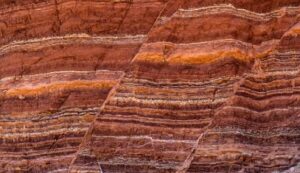
Sedimentary rocks fall into three broad groups: clastic rocks like sandstone, shale, and conglomerate, made of fragments of older rocks; chemical rocks like rock salt and some limestone, which form when dissolved minerals precipitate out of water; and organic rocks like coal and certain limestones, built from the remains of plants and marine organisms. Their layered structure, called bedding, is one of their most recognizable features, and because they often trap fossils and preserve ripples, mud cracks, and other ancient surface features, they are among the most valuable rocks for reconstructing Earth’s past environments and life. Read sedimentary rocks in detail>>>>>>
2. Igneous Rocks
Igneous rocks form when molten rock cools and solidifies, and their name comes from the Latin word for fire. The molten material is called magma when it is underground and lava when it erupts onto the surface, and where it cools determines the rock’s character. Intrusive (plutonic) igneous rocks, such as granite and gabbro, cool slowly deep within the crust, which gives crystals time to grow large enough to see with the naked eye. Extrusive (volcanic) igneous rocks, such as basalt, obsidian, and pumice, cool quickly at or near the surface, producing tiny crystals, a glassy texture, or even gas-bubble holes in the case of pumice.
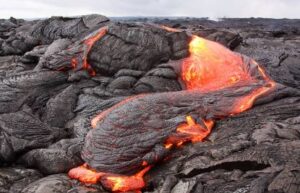
Geologists also classify igneous rocks by their chemical makeup, ranging from silica-rich, light-colored felsic rocks like granite to silica-poor, dark mafic rocks like basalt, with intermediate and ultramafic types in between. They are the primary rocks of the oceanic crust and make up much of the continental crust too, and because they often contain valuable minerals and can be dated using the radioactive elements locked inside their crystals, they are essential both for mining and for working out the age of Earth’s features. Read Igneous Rocks in detail>>>>>
3. Metamorphic Rocks
Metamorphic rocks form when existing rocks, whether igneous, sedimentary, or even older metamorphic ones, are changed by heat, pressure, or chemically active fluids without melting completely. The name comes from the Greek for “change of form,” and the transformation typically happens deep in the crust or where tectonic plates collide. Under these conditions the original minerals recrystallize or react to form new ones, and the rock’s texture changes along with it. Rocks squeezed by directional pressure often develop foliation, a layered or banded appearance in which flat minerals line up in parallel, as seen in slate, schist, and gneiss. Others, such as marble (from limestone) and quartzite (from sandstone), are non-foliated because their minerals recrystallize into an interlocking mosaic without distinct layers.
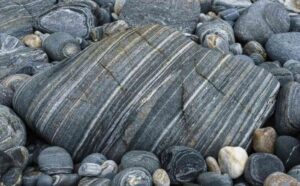
Geologists describe the intensity of change as metamorphic grade, so shale, for example, progresses from slate to phyllite to schist to gneiss as temperature and pressure increase. Because the minerals in metamorphic rocks are stable only within certain temperature and pressure ranges, they act as records of the conditions deep inside mountain belts and subduction zones, and some, like marble and slate, are also widely used in building and sculpture.
What are Rocks made of?
Rocks are made of minerals, and sometimes of non-mineral material like organic matter or volcanic glass. A mineral is a naturally occurring, inorganic solid with a specific chemical composition and an orderly crystal structure.
The building blocks
Most rocks are built from a small set of common minerals, which in turn are made mostly of a handful of elements. Oxygen and silicon alone make up about 75% of the Earth’s crust by weight, followed by aluminum, iron, calcium, sodium, potassium, and magnesium. These combine into silicate minerals (like quartz, feldspar, mica, and olivine), which are by far the most abundant type. Other important groups include carbonates (like calcite), oxides, and sulfides.
How the makeup differs by rock type
- Igneous rocks form when molten rock (magma or lava) cools and crystallizes. Granite, for example, is mostly quartz, feldspar, and mica. Basalt is rich in pyroxene and plagioclase feldspar. Some, like obsidian, cool so fast that they form volcanic glass instead of crystals.
- Sedimentary rocks form from pieces of other rocks, minerals, or organic remains that get compacted and cemented together. Sandstone is mostly quartz grains, limestone is mostly calcite (often from shells and marine organisms), and coal is made of compressed plant material.
- Metamorphic rocks are existing rocks changed by heat and pressure without fully melting. Marble comes from limestone, and slate comes from shale. Their minerals recrystallize or rearrange into new forms.