
Metamorphism
Metamorphism is the process by which an existing rock, called the protolith, is changed in mineral composition, texture, or both by exposure to conditions of heat, pressure, or chemically active fluids that differ from those in which it originally formed. The change occurs in the solid state, below the rock’s melting point, as unstable minerals break down and recrystallize into new minerals that are stable in the new environment. It takes place deep within the Earth’s crust, commonly during mountain building, near magma bodies, along fault zones, or in subduction zones, and it can transform igneous, sedimentary, or even other metamorphic rocks. Examples include limestone becoming marble, shale becoming slate, and granite becoming gneiss, and the resulting metamorphic rocks preserve a record of the temperatures and pressures they experienced.
Types of Metamorphism
Metamorphism is split into types because rocks get transformed by different causes, in different settings, and each leaves its own signature in the rock. Classification helps geologists read a rock’s history: where it was, what forces acted on it, and how intense they were.
Types of Metamorphism caused by agents of change
01. Regional Metamorphism
Regional metamorphism is the large-scale transformation of rock over areas that can span hundreds or thousands of square kilometers, and it occurs mainly during mountain building at convergent plate boundaries, where continental collisions or subduction bury rocks deep in the crust and subject them to both high temperature and strong, directed pressure. Under these conditions the original rock (the protolith) recrystallizes, its minerals realign perpendicular to the squeezing force, and new minerals grow, producing the layered or banded texture known as foliation. As the intensity increases, shale progresses from slate to phyllite, then schist, and finally gneiss, with index minerals such as chlorite, biotite, garnet, and sillimanite marking the metamorphic grade. Because it records the heat and pressure of ancient collisions, regional metamorphism is found today in the cores of old mountain belts and exposed shields, and it is the most widespread and economically significant type of metamorphism.
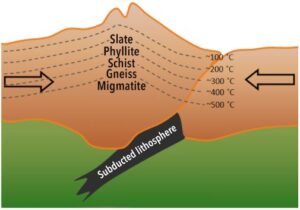
The Himalaya range is an example of where regional metamorphism is happening because two continents are colliding. Sedimentary rocks have been both thrust up to great heights—nearly 9 km above sea level—and also buried to great depths. Considering that the normal geothermal gradient (the rate of increase in temperature with depth) is around 30°C per kilometre in the crust, rock buried to 9 km below sea level in this situation could be close to 18 km below the surface of the ground, and it’s reasonable to expect temperatures up to 500°C. Notice the sequence of rocks beginning with slate higher up where pressures and temperatures are lower, and ending in migmatite at the bottom where temperatures are so high that some of the minerals start to melt. These rocks are all foliated because of the strong compressing force of the converging plates.
02. Contact Metamorphism
Contact metamorphism, also called thermal metamorphism, occurs when hot magma or lava intrudes into cooler country rock and bakes it. The heat is the dominant agent, while pressure is low and mostly confining rather than directed. Because the effect depends on the heat that can travel outward from the intrusion, it is local, creating a zone of altered rock around the igneous body known as the contact aureole. The width of this zone depends on the size, shape, and temperature of the intrusion, as well as the water content and thermal conductivity of the surrounding rock. It can range from a few centimeters around a thin dike to several kilometers around a large batholith.
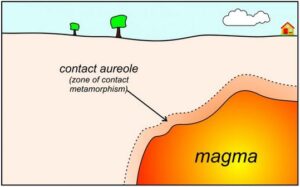
The rocks in the aureole recrystallize without being squeezed in one direction, so they typically lose their original layering and develop a fine to coarse, interlocking, non-foliated texture. Common products include marble from limestone, quartzite from sandstone, and hornfels from shale or basalt. Metamorphic grade usually decreases with distance from the intrusion, so minerals such as andalusite, cordierite, and sillimanite may appear close to the contact, grading outward into lower-grade rock that is only slightly altered. Hot fluids released by the magma can also add new elements to the surrounding rock, forming skarns that are often rich in valuable ore minerals like copper, tungsten, and iron.
03. Dynamic (Cataclastic) Metamorphism
Dynamic metamorphism, also called cataclastic metamorphism, results from intense mechanical stress and shearing, mainly along fault zones and thrust planes, where blocks of crust grind past one another. Directed pressure is the dominant agent, while temperature is generally low to moderate, so the changes are largely physical rather than chemical. The rock is fractured, crushed, and pulverized (the word “cataclastic” comes from the Greek for “broken down”), and the effect is localized to the narrow zone of movement, which can range from a few centimeters to several kilometers wide. At shallow depths, where rocks are brittle, they break apart, while at greater depths, where they are hotter and more ductile, they deform by flowing and recrystallizing instead.
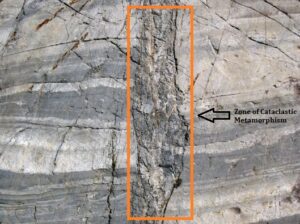
The products depend on depth and the rate of deformation. In the brittle zone, crushing produces loose or cemented fault breccia, made of angular fragments, and finer, powdery fault gouge. In deeper, more ductile zones, intense shearing yields mylonite, a hard, fine-grained, banded rock in which the original grains have been stretched and smeared into streaks. Where friction generates enough heat to melt the rock briefly, glassy pseudotachylite can form. Dynamic metamorphism is important because these rocks record past earthquake activity and fault movement, helping geologists reconstruct how and when faults operated.
04. Hydrothermal Metamorphism
Hydrothermal metamorphism occurs when hot, chemically active water-rich fluids move through fractures and pores in a rock and react with its minerals. The fluids may come from cooling magma bodies, from seawater circulating through newly formed oceanic crust, or from water squeezed out of rocks during deep burial. They typically range from about 100 to 500 °C and carry dissolved ions, so the key agent is the fluid itself rather than heat or pressure alone. As the fluids pass through, they dissolve some minerals, transport elements, and deposit new ones, which changes the rock’s chemical composition as well as its mineralogy. This process of chemical alteration by fluids is called metasomatism, and it is what most clearly separates hydrothermal metamorphism from the other types.
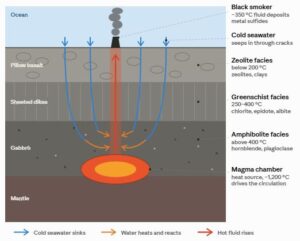
The process is especially widespread at mid-ocean ridges, where seawater percolates down through basaltic crust, is heated by underlying magma, and rises again, altering the basalt into minerals such as chlorite, epidote, and actinolite (greenschist-type assemblages). Hydration of ultramafic rock under these conditions produces serpentinite, a rock rich in serpentine minerals. Hydrothermal fluids are also important economically, because they dissolve metals and redeposit them in veins and around volcanic and intrusive centers, forming ore deposits of copper, gold, silver, lead, and zinc, as well as seafloor “black smoker” sulfide deposits. Studying these altered rocks helps geologists understand how fluids move through the crust and where valuable mineral resources are likely to be found.
05. Burial Metamorphism
Burial metamorphism occurs when sedimentary or volcanic rocks are buried deep in a thick accumulating basin, typically at depths of several kilometers, and are gradually exposed to rising temperature and pressure. Temperatures usually fall in the range of roughly 100 to 300 °C, which is low compared with other types, and the pressure is mainly confining (equal from all directions) rather than directed. Because the stress is not strongly one-sided, the rocks undergo little deformation and do not develop foliation. The process is slow and gradual, affecting large areas of a basin as sediments pile up over millions of years, and it forms a transition between diagenesis (the changes that turn loose sediment into rock) and true metamorphism.
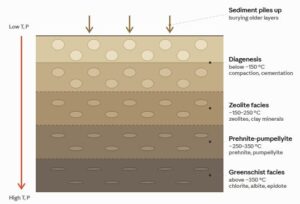
No shearing: the rock stays unfoliated and the layering is preserved.
The changes are mostly mineralogical and textural rather than dramatic. Original minerals become unstable and are replaced by new low-grade ones, such as zeolites (like laumontite and heulandite), prehnite, and pumpellyite, a range often called the zeolite facies. Clay minerals recrystallize, pore spaces shrink, and organic material matures, which is why burial metamorphism is important in the formation of coal and in the generation of oil and gas. Since the rocks often keep their original bedding and sedimentary features, the metamorphism can be hard to recognize, and it is usually identified by the presence of these characteristic minerals. With further burial and increasing heat and pressure, the process grades into regional metamorphism.
06. Subduction Zone (High-Pressure / Low-Temperature) Metamorphism
Subduction zone metamorphism, also called high-pressure/low-temperature (HP/LT) metamorphism, takes place where an oceanic plate sinks into the mantle at a convergent boundary. The descending slab is carried down faster than heat can conduct into it from the surrounding mantle, and cold oceanic crust is a poor conductor, so the rocks reach great depth while staying relatively cool. This produces an unusually low geothermal gradient, with pressures that can exceed 1 to 2 GPa (depths of roughly 30 to 100 km or more) at temperatures of only about 200 to 600 °C. The pressure is largely confining, though shearing along the plate interface adds deformation. The setting is the opposite of the high-temperature, low-pressure conditions of contact metamorphism, and the rocks form in a narrow, elongated belt along the subducting plate boundary.
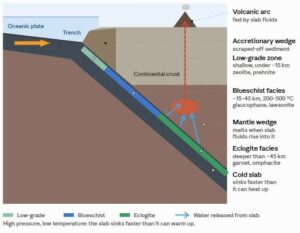
The metamorphosed oceanic crust and sediments develop distinctive dense, high-pressure minerals. Basalt first changes to blueschist, which gets its color from the blue sodium-rich amphibole glaucophane, and with deeper burial transforms to eclogite, a very dense rock made mostly of red garnet and green omphacite pyroxene. During this process, minerals release water, and these fluids rise into the overlying mantle wedge, lowering its melting point and feeding the volcanoes of island arcs and continental margins. Blueschists and eclogites are rarely found at the surface because they tend to revert as they are heated and decompressed, so their presence in ancient mountain belts is valuable evidence of former subduction zones and shows that plate tectonics has operated in the past.
07. Shock Metamorphism
Shock metamorphism, also called impact metamorphism, occurs when a meteorite or comet strikes the Earth’s surface at hypervelocity, generating a shock wave that passes through the target rock in a fraction of a second. Pressures can reach hundreds of gigapascals, vastly higher than anything in regular crustal processes, and temperatures can climb to thousands of degrees, but only for microseconds to seconds. Because the event is so brief, rocks do not have time to reach chemical equilibrium, so the changes are often structural and instantaneous rather than gradual. The effects are confined to the impact site and its immediate surroundings, forming a crater, and are recognized as one of the rarest yet most dramatic types of metamorphism on Earth.
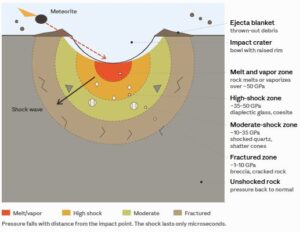
The shock leaves distinctive, diagnostic features that help geologists confirm that a structure is an impact crater rather than a volcanic one. These include high-pressure mineral forms such as coesite and stishovite (dense polymorphs of quartz), microscopic diamonds formed from carbon, and shatter cones, which are striated, cone-shaped fracture patterns in the rock. Quartz grains often show planar deformation features, which are thin parallel lamellae that form only under shock. Intense heat can also melt the rock to form impact glass and breccias such as suevite, which contain melted and fragmented material. Well-known examples include Meteor Crater in Arizona, the Ries crater in Germany, and the Chicxulub crater in Mexico, whose impact is linked to the end-Cretaceous mass extinction.
Grade of Metamorphism
Metamorphic grade is the intensity of metamorphism, meaning how far a rock has changed from its original state (the protolith). It mainly reflects the temperature (and, to a lesser degree, the pressure) the rock reached. A low-grade rock has changed only slightly, while a high-grade rock has been transformed so thoroughly that its original features may be unrecognizable.
Grade is a progressive concept. As a rock is buried deeper or heated more, it moves through increasing grades. This is called prograde metamorphism. When a rock cools and decompresses and adjusts to lower conditions, the process is retrograde metamorphism.
The main grades
| Grade | Approx. temperature | Typical conditions |
|---|---|---|
| Very low grade | ~150-250 °C | Transition from diagenesis (burial metamorphism) |
| Low grade | ~200-400 °C | Shallow depth, mild heat |
| Medium grade | ~400-600 °C | Moderate depth, strong heat and pressure |
| High grade | ~600-800 °C and above | Deep crust, intense heat, near the onset of melting |
The boundaries are approximate and vary with pressure, rock composition, and fluids.
How rocks change with grade
Using shale as the example (the classic sequence for regional metamorphism):
- Slate (low grade): Very fine-grained, with flat cleavage surfaces. Grains are too small to see, and the rock splits into thin, smooth sheets.
- Phyllite (low to medium grade): Slightly coarser, with a silky sheen from tiny mica flakes and a wavy surface.
- Schist (medium grade): Grains are visible to the naked eye, and mica flakes are aligned into a strongly foliated texture called schistosity.
- Gneiss (high grade): Coarse-grained, with alternating light bands (quartz and feldspar) and dark bands (biotite, hornblende). This is gneissic banding.
- Migmatite (very high grade): Partial melting begins, producing a mix of metamorphic rock and igneous-looking streaks. This marks the transition toward magma.
As grade rises, three trends stand out:
- Grain size increases because heat promotes recrystallization.
- Foliation develops and coarsens, going from slaty cleavage to schistosity to gneissic banding.
- Mineral assemblages change to minerals that are stable at higher temperature.
Index minerals
Geologists use index minerals, which form only within certain temperature-pressure ranges, to determine grade. For pelitic (clay-rich) rocks, the sequence worked out by George Barrow in the Scottish Highlands is:
Chlorite → Biotite → Garnet → Staurolite → Kyanite → Sillimanite
- Chlorite: low grade
- Biotite: low to medium grade
- Garnet: medium grade
- Staurolite and kyanite: medium to high grade
- Sillimanite: high grade
Kyanite and sillimanite have the same composition (Al₂SiO₅) but different crystal structures, so they reveal different pressure-temperature conditions. Andalusite, the third polymorph, forms at low pressure, as in contact metamorphism.
A line on a map joining points where an index mineral first appears is called an isograd, and the areas between isograds are metamorphic zones. Mapping them shows how conditions changed across a region.
Metamorphic facies
Because different rock types produce different minerals, geologists also use metamorphic facies, which are groups of mineral assemblages that form under a specific range of pressure and temperature. For mafic rocks like basalt, the prograde sequence is:
- Zeolite → Prehnite-pumpellyite: very low grade
- Greenschist: low grade (chlorite, actinolite, epidote)
- Amphibolite: medium to high grade (hornblende, plagioclase)
- Granulite: high grade (pyroxene, no hydrous minerals)
Two other facies reflect different pressure-temperature paths rather than simply higher grade:
- Blueschist and eclogite: high pressure, low temperature (subduction zones)
- Hornfels: high temperature, low pressure (contact metamorphism)
Factors controlling grade
- Temperature: the main driver, set by depth, the geothermal gradient, and nearby intrusions.
- Pressure: affects which minerals are stable and how dense they are.
- Fluids: speed up reactions and carry ions. Higher-grade rocks tend to be drier because water has been driven off.
- Time: longer exposure allows reactions to go further toward equilibrium.
- Protolith composition: determines which minerals can form at all. For example, pure limestone becomes marble at nearly any grade, so it gives little grade information.
Why grade matters
- It lets geologists reconstruct the depth, temperature, and tectonic setting of ancient metamorphism.
- Mapping grade across a region reveals the structure of mountain belts, such as where the deepest crust was exposed.
- It helps locate mineral resources, since garnet, graphite, and certain gemstones form at specific grades.
- It marks the upper limit of metamorphism, where high-grade rocks begin to melt and become igneous.