
Metamorphic Rocks
Metamorphic rocks are rocks that have been transformed from an existing rock type (igneous, sedimentary, or even another metamorphic rock) by intense heat, pressure, or chemically active fluids, all without melting completely. This process, called metamorphism, typically occurs deep within the Earth’s crust, often near tectonic plate boundaries or magma bodies, and it changes the rock’s mineral composition and texture while keeping it solid. The original rock, called the protolith, recrystallizes into new minerals that are stable under the new conditions. For example, limestone becomes marble, shale becomes slate and then schist, and granite can become gneiss. Metamorphic rocks are broadly classified as foliated, which show a layered or banded appearance caused by directed pressure aligning mineral grains (such as slate, schist, and gneiss), or non-foliated, which lack this layering and tend to have a more uniform, crystalline texture (such as marble and quartzite). Because they record the temperature and pressure conditions they formed under, metamorphic rocks give geologists valuable clues about the history of mountain building and other deep-Earth processes.
Examples of Metamorphic Rocks
Here is a list of the main metamorphic rocks. There are many local varieties, so “all” isn’t strictly possible, but this covers the commonly recognized ones.
| Rock | Type / Key Characteristics |
|---|---|
| Slate | Foliated; fine-grained, splits into flat sheets; low-grade, from shale |
| Phyllite | Foliated; silky sheen, between slate and schist; low-grade |
| Schist | Foliated; visible platy minerals like mica; medium to high-grade |
| Gneiss | Foliated; coarse, banded light and dark minerals; high-grade |
| Migmatite | Foliated/banded; mix of metamorphic and partly melted igneous material |
| Mylonite | Foliated; fine-grained, formed by shearing in fault zones |
| Amphibolite | Foliated or massive; dominated by amphibole and plagioclase; from basalt |
| Granulite | Weakly foliated; high-grade, coarse, dry mineral assemblage |
| Eclogite | Non-foliated or weakly foliated; very high pressure; garnet and pyroxene |
| Blueschist | Foliated; high-pressure, low-temperature; blue amphibole (glaucophane) |
| Greenschist | Foliated; low-grade; green minerals like chlorite and epidote |
| Marble | Non-foliated; recrystallized calcite or dolomite, from limestone |
| Quartzite | Non-foliated; very hard, recrystallized quartz, from sandstone |
| Hornfels | Non-foliated; fine-grained, formed by contact metamorphism near magma |
| Anthracite | Non-foliated; high-grade coal, hard and shiny |
| Metaconglomerate | Non-foliated; deformed, recrystallized conglomerate with stretched pebbles |
| Skarn | Non-foliated; calcium-silicate rock formed at limestone-magma contacts |
| Soapstone | Non-foliated or weakly foliated; soft, rich in talc |
| Serpentinite | Non-foliated or weakly foliated; formed from ultramafic rocks; green, waxy |
| Novaculite | Non-foliated; extremely fine-grained, dense silica rock from chert |
| Fault breccia / Cataclasite | Non-foliated; crushed and re-cemented rock from brittle fault movement |
| Phyllonite | Foliated; sheared phyllite-like rock with a silky, mica-rich surface |
| Metapelite | Foliated; general term for metamorphosed mudstone/shale with aluminum-rich minerals |
| Calc-silicate rock | Non-foliated; formed from impure limestone or dolostone |
How are Metamorphic Rocks formed?
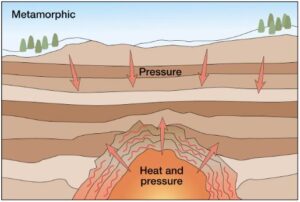
Metamorphic rocks form when an existing rock, called the protolith, which may be igneous, sedimentary, or already metamorphic, is subjected to conditions very different from those in which it originally formed, causing it to change in the solid state without melting. The main agents of this change are heat, pressure, and chemically active fluids. Heat typically comes from deep burial, where temperatures rise with depth, or from nearby magma intrusions, and it provides the energy needed for atoms to rearrange and for minerals to recrystallize. Pressure comes in two forms: confining pressure, which squeezes a rock equally from all directions and makes its minerals denser and more compact, and directed stress, which is common at converging plate boundaries and flattens the rock, aligning platy minerals like mica into parallel layers known as foliation. Hot, watery fluids moving through the rock can also dissolve existing minerals and deposit new ones, altering the rock’s chemical composition in a process called metasomatism. These changes occur in several settings: regional metamorphism affects vast areas during mountain building, as when continents collide; contact metamorphism occurs in a narrow zone around a hot igneous intrusion; and dynamic or fault-zone metamorphism results from intense shearing along faults. Because minerals are stable only within particular temperature and pressure ranges, the original minerals break down and recrystallize into new ones suited to the new conditions, which is why shale becomes slate, then schist, and eventually gneiss as the intensity, or grade, of metamorphism increases. If temperatures climb high enough that the rock begins to melt, the process crosses over into igneous formation, so metamorphism is defined as occurring below the melting point.
Metamorphism
Metamorphism is the process by which rocks change in mineral composition, texture, or both in response to new physical and chemical conditions, while remaining essentially solid. It occurs between the realm of diagenesis (low-temperature changes in sediments, below roughly 150-200°C) and melting (which begins at roughly 650-1,200°C depending on rock composition, pressure, and water content). The starting rock is the protolith, and the result is a rock that is in equilibrium with its new environment. Read Metamorphism in detail>>>>
Why rocks change
Every mineral is stable only within a certain range of temperature, pressure, and chemical environment. When a rock is moved outside the conditions where its minerals formed, those minerals become unstable. Atoms diffuse and rearrange, old minerals break down, and new minerals grow. This happens slowly, over thousands to millions of years, through solid-state diffusion and with the help of small amounts of fluid along grain boundaries.
The agents of metamorphism
Temperature. This is the main driver. It comes from deep burial (the geothermal gradient averages about 25-30°C per kilometer), from nearby magma, or from tectonic processes. Heat gives atoms the energy to move, which causes recrystallization: small grains merge into larger ones, and new minerals form. This is why fine-grained limestone becomes coarse-grained marble.
Pressure. There are two kinds:
- Confining (lithostatic) pressure acts equally in all directions from the weight of overlying rock. It compacts minerals into denser structures, such as garnet replacing less dense minerals at depth.
- Differential stress is stronger in one direction than others, typically from tectonic squeezing. It deforms the rock, flattens grains, and causes platy or elongated minerals (mica, amphibole) to grow perpendicular to the direction of maximum stress. This produces foliation.
Chemically Modifier. Water and other fluids, mostly hot water carrying dissolved ions, circulate through rock pores and fractures. They speed up reactions by acting as a transport medium, and they can add or remove elements. When the overall chemistry of the rock changes, the process is called metasomatism. Skarns and serpentinites are common examples.
Time. Metamorphic reactions are slow, so duration matters. Rocks held at moderate conditions for a long time can reach a more complete transformation than rocks briefly exposed to the same conditions. Read Metamorphism in detail>>>>
Types of Metamorphic Rocks
Metamorphic rocks are classified mainly by texture, meaning whether their minerals are aligned into layers (foliated) or not (non-foliated). Within each group, rocks are further separated by grain size, mineral content, and metamorphic grade.
1. Foliated metamorphic rocks
These form under directed pressure, which aligns platy or elongated minerals such as mica and amphibole into parallel layers or bands. They are arranged here in order of increasing grade.
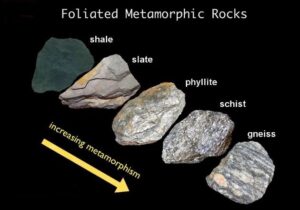
Slate. Very fine-grained and dense, it splits into smooth, flat sheets (slaty cleavage). It forms at low grade from shale or mudstone and is used for roofing, flooring, and blackboards.
Phyllite. A step above slate, with slightly larger mica crystals that give it a silky, wavy sheen. It is still fine-grained, and individual minerals are barely visible.
Schist. Medium to coarse-grained, with visible, sparkling mica flakes aligned in layers (schistosity). It often contains garnet, staurolite, or kyanite, and it splits easily along its mica layers. It forms at medium to high grade.
Gneiss. Coarse-grained, with distinct alternating light bands (quartz, feldspar) and dark bands (biotite, amphibole). It forms at high grade from granite, shale, or other rocks.
Migmatite. A mixed rock that is part metamorphic and part igneous, formed at the edge of melting when some of the gneiss partially melts and then cools within the surrounding rock. It shows swirling or folded bands.
Mylonite. A fine-grained, banded rock formed by intense shearing in ductile fault zones, where grains are crushed and stretched into thin streaks.
Amphibolite. Made mostly of amphibole and plagioclase, it is dark with a weak to moderate foliation. It usually forms from basalt or similar mafic rocks at medium to high grade.
Greenschist and blueschist. These are named for their key minerals (green chlorite and epidote, or blue glaucophane). Greenschist forms at low grade, and blueschist forms at high pressure and low temperature in subduction zones.
2. Non-foliated metamorphic rocks
These lack layering. They form when the protolith is made of one mineral (or a few equidimensional minerals), or when heat acts without strong directed stress, as in contact metamorphism.
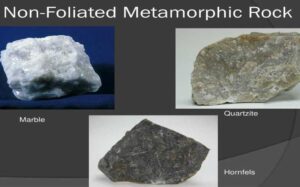
Marble. Recrystallized calcite or dolomite from limestone or dolostone. It has interlocking crystals that give a sugary, sparkling look. It is soft and widely used for sculpture and building.
Quartzite. Formed from quartz sandstone. Quartz grains fuse together, so it breaks across grains rather than around them. It is extremely hard and durable.
Hornfels. A dense, fine-grained rock formed by contact metamorphism near hot magma. It is hard, often dark, and breaks with a splintery or conchoidal fracture.
Anthracite. Coal that has been metamorphosed into a hard, shiny, high-carbon form. It burns hotter and cleaner than lower-grade coal.
Metaconglomerate. Conglomerate that has been compressed and recrystallized, so its pebbles are often stretched or flattened.
Skarn. A calcium-silicate rock formed where magma meets limestone or dolostone, often rich in minerals such as garnet and epidote and sometimes associated with ore deposits.
Soapstone. A soft rock rich in talc, with a smooth, soapy feel. It is easy to carve and holds heat well.
Serpentinite. A green, waxy rock formed when water alters ultramafic rock such as peridotite. It is made mostly of serpentine minerals.
Novaculite. An extremely fine-grained, dense silica rock formed from chert, historically used as a whetstone.
Cataclasite and fault breccia. Crushed and re-cemented rock formed by brittle fault movement near the surface.
3. Types by how they form
Metamorphic rocks can also be grouped by the process that produced them:
- Regional metamorphic rocks: slate, schist, gneiss, and amphibolite, from large-scale mountain building.
- Contact metamorphic rocks: hornfels, marble, and skarn, from heat around magma bodies.
- Dynamic (fault-zone) metamorphic rocks: mylonite and cataclasite, from shearing along faults.
- High-pressure rocks: blueschist and eclogite, from subduction zones.
- Hydrothermal rocks: serpentinite and greenschist, from hot, chemically active fluids.
Quick comparison
| Group | Texture | Example rocks | Typical formation |
|---|---|---|---|
| Foliated | Layered or banded | Slate, phyllite, schist, gneiss | Regional metamorphism |
| Non-foliated | Uniform, interlocking crystals | Marble, quartzite, hornfels | Contact metamorphism or single-mineral protoliths |
Uses of Metamorphic Rocks
Metamorphic rocks are useful because the heat and pressure that formed them often make them harder, denser, more durable, or more attractive than the original rock. Different types suit different jobs, from building skyscrapers to carving sculptures to producing fuel and industrial minerals.
1. Construction and building
Marble
- Building stone and cladding. Marble has been used in major buildings and monuments for thousands of years, including the Parthenon in Greece, the Taj Mahal in India, and the Lincoln Memorial in the US.
- Flooring and wall tiles. Polished marble is used in lobbies, bathrooms, staircases, and decorative walls because it takes a high shine and has natural veining.
- Countertops and vanities. Marble is popular in kitchens and bathrooms. It is relatively soft and reacts with acids (lemon juice, vinegar, wine), so it can etch and stain and needs sealing.
- Crushed marble is used as decorative aggregate in terrazzo flooring, landscaping, and concrete finishes.
Slate
- Roofing. Slate splits into thin, flat, waterproof sheets and is fire-resistant. Slate roofs can last 100 years or more.
- Flooring and paving. Its natural cleft texture gives good grip, so it is used for patios, walkways, and floors.
- Wall cladding and cemetery markers also use slate because it resists weathering.
- Traditional uses: blackboards, writing slates, billiard (pool) table beds, and electrical switchboards, thanks to its flatness and insulating properties.
Quartzite
- Countertops, flooring, and cladding. It is harder than marble and much more resistant to scratches and acids. It is often sold as a premium natural stone.
- Crushed stone. It is used as road base, concrete aggregate, and railroad ballast because of its extreme hardness and durability.
Gneiss and schist
- Dimension and crushed stone. Gneiss is used for building facades, paving, retaining walls, and aggregate. It resembles granite in appearance and strength.
- Schist is less often used for building because it splits along its mica layers, but it is used for decorative stone walls and landscaping where that natural splitting is useful.
Hornfels and amphibolite are very hard and dense, so they are crushed for road aggregate and used as construction fill.
2. Sculpture, art, and monuments
- Marble is the classic sculptor’s stone. Its fine, even grain and slight translucency let light penetrate the surface, giving figures a lifelike glow. Michelangelo’s David is carved from Carrara marble.
- Soapstone is soft, easy to carve, and smooth to the touch. It is used for sculptures, figurines, and carved ornaments in many cultures, including Inuit art.
- Serpentinite is used for carved ornaments and decorative objects because it is soft and takes a polish.
- Gravestones and memorials are commonly made of marble, slate, or gneiss because they hold carved lettering and resist weathering.
3. Fuel and energy
- Anthracite is the highest-grade coal, formed by metamorphism of lower coal types. It has high carbon content, burns hot with little smoke, and is used for home heating and some industrial processes. It is also used in water filtration and metallurgical applications.
- Graphite, produced by metamorphism of carbon-rich sediments, is used in lithium-ion battery electrodes, pencils, lubricants, and crucibles.
4. Industrial minerals and raw materials
From marble and other calcium carbonate rocks
- Lime and cement. Calcium carbonate is heated to make lime, a key ingredient in cement, mortar, and plaster.
- Agricultural lime neutralizes acidic soils.
- Fillers and whiteners. Ground marble (calcium carbonate) is added to paper, paint, plastics, rubber, and toothpaste, and is used in some antacids and calcium supplements.
- Environmental uses. Crushed marble can neutralize acidic water and flue gas emissions.
From soapstone
- Talc is used in cosmetics, paper, paints, ceramics, and plastics.
- Heat-retaining stone. Soapstone absorbs and releases heat slowly and resists chemicals and heat, so it is used for wood-stove liners, fireplaces, laboratory countertops, sinks, and cookware.
From quartzite
- High-purity silica is used to make glass, silicon metal, ferrosilicon (used in steelmaking), and refractory bricks lining furnaces.
From schist and other metamorphic rocks
- Mica is used in electrical insulation, cosmetics (shimmer pigments), paints, and as a filler.
- Garnet from schist and gneiss is crushed into an abrasive for sandblasting, waterjet cutting, and sandpaper.
- Kyanite and sillimanite, aluminum silicate minerals, are used in high-temperature ceramics, porcelain, and furnace linings.
- Wollastonite, formed in skarns and marbles, is used in ceramics, paints, and as a substitute for asbestos.
Novaculite is a fine-grained silica rock historically used to make whetstones for sharpening knives and tools.
5. Gemstones and ornamental stones
Several gemstones form during metamorphism:
- Garnet (schist, gneiss), ruby and sapphire (marble and some schists), emerald (some schists), lapis lazuli (metamorphosed limestone), and jade (both jadeite and nephrite, associated with metamorphic rocks and subduction zones).
- Marble and serpentinite with attractive colors are cut into beads, tabletops, and decorative objects.
6. Ore deposits and mining
Metamorphism and the hot fluids involved can concentrate valuable minerals:
- Skarn deposits, formed where magma meets limestone, are important sources of copper, iron, tungsten, zinc, lead, and gold.
- Hydrothermal veins within metamorphic belts host gold, silver, and other metals.
- Metamorphic terrains are also mined for graphite, garnet, and gemstones.
Geologists use the presence of metamorphic rocks as a guide when exploring for these resources.
7. Scientific and educational uses
- Geological research. Metamorphic rocks record the pressure and temperature history of mountain belts, collision zones, and subduction zones. Index minerals and metamorphic facies allow geologists to reconstruct ancient plate movements and crust formation.
- Dating and tracing Earth history. Minerals in metamorphic rocks can be dated radiometrically to determine when an event occurred.
- Education. They are widely used in classrooms and museums to teach rock cycle and plate tectonic concepts.
8. Other practical and environmental uses
- Water filtration and drainage. Crushed hard metamorphic rock is used as filter media and drainage aggregate.
- Soil formation. Weathering of metamorphic rocks supplies minerals to soils.
- Landscaping. Slate chips, marble chips, and decorative boulders are widely used in gardens and public spaces.
Limitations and cautions
- Marble is vulnerable to acid rain and spills, which dissolve or etch the surface. Outdoor marble statues can lose detail over time.
- Slate can flake or split if poorly installed or freeze-thaw cycles affect it.
- Serpentinite can contain chrysotile asbestos, a fibrous mineral once widely used for insulation and fireproofing. It is now a recognized health hazard, so asbestos mining and use are heavily restricted in many countries.
- Mining and quarrying can cause dust, habitat disruption, and water pollution if poorly managed.