
Igneous Rocks
Igneous rocks are formed from the cooling and solidification of molten rock, called magma when it is underground and lava when it erupts at the surface. The rate of cooling determines the rock’s texture: magma that cools slowly beneath the surface produces coarse-grained intrusive rocks like granite, where large crystals have time to grow, while lava that cools quickly at the surface produces fine-grained or glassy extrusive rocks like basalt and obsidian. They are also classified by composition, ranging from silica-rich, light-colored felsic rocks (granite, rhyolite) to silica-poor, dark mafic rocks (basalt, gabbro). Igneous rocks form at mid-ocean ridges, subduction zones, and hot spots, and they make up most of the Earth’s crust. As part of the rock cycle, they can later be broken down into sediment or transformed by heat and pressure into other rock types.
Examples of Igneous Rocks
| Rock | Type | Texture | Composition | Color | Common Uses / Notes |
|---|---|---|---|---|---|
| Granite | Intrusive | Coarse-grained | Felsic | Light (pink, gray, white) | Countertops, monuments, building stone |
| Diorite | Intrusive | Coarse-grained | Intermediate | Salt-and-pepper gray | Decorative stone, construction aggregate |
| Gabbro | Intrusive | Coarse-grained | Mafic | Dark green to black | Crushed stone, “black granite” countertops |
| Peridotite | Intrusive | Coarse-grained | Ultramafic | Green | Main rock of the upper mantle; source of olivine |
| Syenite | Intrusive | Coarse-grained | Felsic to intermediate | Light gray, pink | Building and ornamental stone |
| Pegmatite | Intrusive | Very coarse (giant crystals) | Usually felsic | Varies | Source of gems and minerals like mica, tourmaline, lithium |
| Rhyolite | Extrusive | Fine-grained | Felsic | Light (pink, gray) | Volcanic equivalent of granite |
| Andesite | Extrusive | Fine-grained | Intermediate | Gray | Common in volcanic arcs such as the Andes |
| Basalt | Extrusive | Fine-grained | Mafic | Dark gray to black | Most common volcanic rock; forms ocean floor, road base |
| Obsidian | Extrusive | Glassy | Felsic | Black | Volcanic glass; used historically for tools and blades |
| Pumice | Extrusive | Frothy, porous | Felsic | Light gray, white | So light it can float; used as an abrasive |
| Scoria | Extrusive | Vesicular (bubbly) | Mafic | Dark red to black | Landscaping, lightweight aggregate |
| Tuff | Extrusive | Fragmental (compacted ash) | Varies | Light gray, tan | Used as building stone (e.g., in ancient Rome) |
| Porphyry | Either | Porphyritic (large crystals in fine matrix) | Varies | Varies | Ornamental stone; often associated with copper deposits |
How are the Igneous Rocks formed
Igneous rocks form through a sequence of stages: melting, magma movement, crystallization, and solidification. The way each stage plays out determines the rock’s type, texture, and composition.
1. Origin of Magma
The Earth’s interior is hot, but most of the mantle and crust is solid because of the enormous pressure. Rock melts only when conditions change. This happens in three main ways:
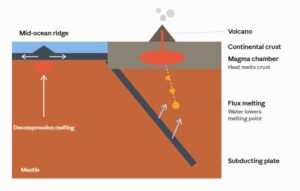
- Decompression melting: When hot mantle rock rises toward the surface (at mid-ocean ridges or under rifts), the pressure on it drops. The rock is still hot but no longer squeezed, so it begins to melt. This is the main source of basaltic magma.
- Flux melting (addition of volatiles): Water and carbon dioxide released from a sinking oceanic plate rise into the overlying mantle and lower its melting point. This is how magma forms at subduction zones.
- Heat-transfer melting: Hot magma rising into the crust can melt the surrounding rock, producing new magma, often silica-rich.
Rocks do not melt all at once. They melt partially, with the minerals that have the lowest melting points liquefying first. This is why magma is often richer in silica than the rock it came from.
2. Ascent and Evolution of Magma
Magma is less dense than the solid rock around it, so it rises through cracks and weak zones. As it travels, it changes in several ways:
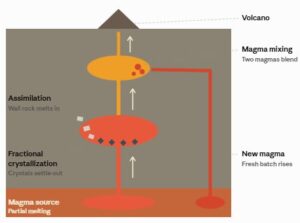
- Fractional crystallization: As magma cools, certain minerals crystallize first and settle out, changing the composition of the remaining liquid. This is described by Bowen’s reaction series. High-temperature minerals (olivine, pyroxene, calcium-rich plagioclase) form first, and low-temperature minerals (sodium-rich plagioclase, muscovite, potassium feldspar, quartz) form last.
- Assimilation: Magma melts and absorbs some of the surrounding crustal rock, altering its chemistry.
- Magma mixing: Two different magmas can blend to form a new composition.
Through these processes, one parent magma can produce a variety of rock types.
3. Cooling and Crystallization
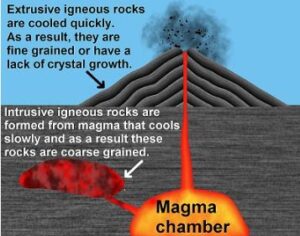
Once magma stops rising, it begins to cool. Atoms in the liquid arrange themselves into orderly crystal structures. The place and speed of cooling decide what kind of igneous rock results.
A. Intrusive (Plutonic) Igneous Rocks
-
- Magma cools slowly, deep underground, insulated by surrounding rock, over thousands to millions of years.
- Slow cooling gives crystals time to grow large, producing a coarse-grained (phaneritic) texture that is visible to the naked eye.
- The magma bodies form structures such as batholiths (huge masses), stocks, laccoliths, sills (parallel to rock layers), and dikes (cutting across layers).
- Examples: granite, diorite, gabbro, peridotite.
B. Extrusive (Volcanic) Igneous Rocks
-
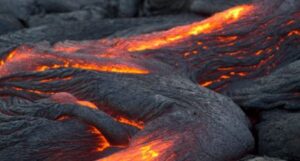
- Magma erupts as lava or is blasted out as ash and fragments, then cools rapidly at or near the surface, from seconds to a few years.
- Fast cooling leaves little time for crystals to grow, producing a fine-grained (aphanitic) texture.
- Examples: basalt, andesite, rhyolite.
C. Special Textures Caused by Cooling Conditions
-
- Glassy texture: Extremely rapid cooling prevents any crystals from forming, as in obsidian.
- Vesicular texture: Dissolved gases escape as the lava solidifies, leaving bubble holes, as in pumice and scoria.
- Porphyritic texture: Magma cools in two stages, slowly at first (forming large crystals called phenocrysts) and then quickly (forming a fine-grained groundmass), as in porphyry.
- Pyroclastic (fragmental) texture: Explosive eruptions throw out ash and fragments that settle and fuse together, forming rocks like tuff.
- Pegmatitic texture: Water-rich magma allows extremely large crystals to grow, as in pegmatite.
4. Role of Composition
The chemistry of the magma, mainly its silica (SiO₂) content, controls both the minerals that form and how the magma behaves:
| Magma Type | Silica Content | Viscosity | Typical Eruption Style | Rock Examples |
|---|---|---|---|---|
| Felsic | High (>65%) | Very thick | Explosive | Granite, rhyolite |
| Intermediate | Medium (55-65%) | Moderate | Moderately explosive | Diorite, andesite |
| Mafic | Low (45-55%) | Runny | Gentle, flowing | Gabbro, basalt |
| Ultramafic | Very low (<45%) | Very runny | Rarely erupts today | Peridotite |
5. Where Igneous Rocks Form
- Divergent boundaries (mid-ocean ridges, rifts): Decompression melting produces basalt and gabbro, creating new oceanic crust.
- Convergent boundaries (subduction zones): Flux melting produces andesitic and granitic magma, building volcanic arcs and continental crust.
- Hot spots (like Hawaii): Plumes of hot mantle rising from deep inside the Earth produce large volumes of basalt.
6. Final Stage: Solidification
When the temperature falls below the solidification point of the last remaining liquid, the entire mass becomes a solid, interlocking network of mineral crystals (or glass). Intrusive rocks may be exposed at the surface only after millions of years of uplift and erosion strip away the rock above them.
Classification of Igneous Rocks
Igneous rocks are classified on two main bases: how and where they formed (origin and texture) and what they are made of (chemical and mineral composition).
1. Classification by Origin (Mode of Occurrence)
| Class | Where It Cools | Cooling Rate | Texture | Examples |
|---|---|---|---|---|
| Intrusive (Plutonic) | Deep underground | Very slow | Coarse-grained (phaneritic) | Granite, diorite, gabbro, peridotite |
| Extrusive (Volcanic) | At or near the surface | Rapid | Fine-grained (aphanitic) or glassy | Rhyolite, andesite, basalt, obsidian |
| Hypabyssal (Sub-volcanic) | Shallow depths (dikes, sills) | Intermediate | Medium-grained or porphyritic | Dolerite (diabase), porphyry |
2. Classification by Texture
Texture describes the size, shape, and arrangement of crystals, and it reflects the cooling history.
- Phaneritic: Crystals large enough to see without a lens (granite, gabbro).
- Aphanitic: Crystals too small to see (basalt, rhyolite).
- Porphyritic: Large crystals (phenocrysts) set in a fine-grained groundmass (porphyry).
- Glassy (vitreous): No crystals, because of extremely fast cooling (obsidian).
- Vesicular: Contains gas bubble holes (pumice, scoria).
- Pyroclastic: Made of compacted volcanic ash and fragments (tuff, volcanic breccia).
- Pegmatitic: Exceptionally large crystals, over 1 cm to several meters (pegmatite).
3. Classification by Chemical Composition (Silica Content)
| Class | SiO₂ Content | Main Minerals | Color | Intrusive Example | Extrusive Example |
|---|---|---|---|---|---|
| Felsic (Acidic) | > 65% | Quartz, potassium feldspar, sodium-rich plagioclase, muscovite | Light | Granite | Rhyolite |
| Intermediate | 55-65% | Plagioclase, amphibole, biotite | Medium gray | Diorite | Andesite |
| Mafic (Basic) | 45-55% | Calcium-rich plagioclase, pyroxene, olivine | Dark | Gabbro | Basalt |
| Ultramafic (Ultrabasic) | < 45% | Olivine, pyroxene | Very dark, green | Peridotite | Komatiite (rare) |
4. Combined Classification Chart
This chart combines texture and composition, which is the most commonly used scheme.
| Texture ↓ / Composition → | Felsic | Intermediate | Mafic | Ultramafic |
|---|---|---|---|---|
| Coarse-grained (Intrusive) | Granite | Diorite | Gabbro | Peridotite |
| Fine-grained (Extrusive) | Rhyolite | Andesite | Basalt | Komatiite |
| Glassy | Obsidian | Obsidian | Rare | — |
| Vesicular | Pumice | Pumice / Scoria | Scoria | — |
| Pyroclastic | Rhyolitic tuff | Andesitic tuff | Basaltic tuff | — |
5. Classification by Mineral Content (Color Index)
Rocks can also be grouped by the proportion of dark (mafic) minerals:
- Leucocratic: Light-colored, with less than 30% dark minerals (granite).
- Mesocratic: Medium-colored, with 30-60% dark minerals (diorite).
- Melanocratic: Dark-colored, with 60-90% dark minerals (gabbro).
- Ultramafic (Hypermelanic): Over 90% dark minerals (peridotite).
6. Classification by Depth of Emplacement (Intrusive Bodies)
- Batholiths: Very large masses (over 100 km²) of deep-seated rock.
- Stocks: Smaller bodies (under 100 km²).
- Laccoliths: Dome-shaped bodies that push up overlying layers.
- Sills: Sheet-like bodies parallel to rock layers.
- Dikes: Sheet-like bodies cutting across rock layers.